While China had hopped that 2008 would be the year China would show off how wonderful things are, it so far hasn't turned out that way.
First came the snow storms that struck China during the New Years Holiday. If you're one of the 150 - 200 million Chinese migrant workers (you read that right, and if you don't believe me, go to cnn.com) then New Years is the only holiday you get off, and its the only time that you get to go back to your home province to visit your family. The snow storms that struck China this year were the worst in over 50 years and stranded millions of people at railway and bus stations waiting to go home to see their friends and family. Never before had so many people been prevented from traveling because of bad weather. Meanwhile, the rest of the nation saw the worst power outages and utility interruptions since the Communist Party took over back in 1949. The damage from the storms were totaled at being over 7 billion dollars.


 So what do you do when almost 20 percent of your population is stranded in transit stations, angry at how they're spending their one time off of the year? Well President Hu and his crew knew that even the image of doing something was better than doing nothing. Primer Wen was quickly dispatched to the hardest hit areas and even Hu himself toured other areas and made sure to be seen on tv trying to fix the situation. Eventually, the crisis faded away as people started trickling home (in case you're wondering if these stranded workers got any extra time off - well I looked around on the Internet and - scary to say - could not find an answer).
.jpg)
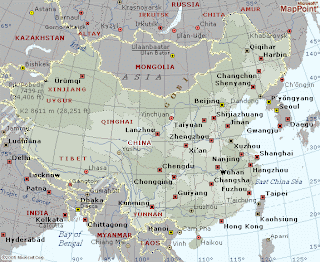
Then in March came the uprising in Tibet - the largest since the major uprising in 1989. There were many different reasons why it occurred, but the end was the same as in 1989, with government troops and state police cracking down on the demonstrators. Just like in the demonstrations in Burma last year, the demonstrations in Tibet started with Buddhist monks protesting - this time to remember the events of 1959, which was the last time Tibet erupted in a full scale rebellion (it also caused the Dali Lama to flee to India during the crackdown). When the original monks were arrested, their fellow monks came out in larger numbers asking for their release, and soon large number or ordinary Tibetans joined in also. Soon, the demonstrations spread throughout Tibet and other areas of China with large Tibetan populations (when China took over Tibet in 1950, it annexed whole sections of Tibet and incorporated them into existing provinces of China). Besides marching protesting Chinese rule, the Tibetans also rioted, attacking government buildings and neighborhoods where Han Chinese lived. To no one's surprise, President Hu (who was one of the leaders in the 1989 crackdown) sent in the army to end the riots, with the dead being estimated at over 100. The Tibetans had many grievances, from being second class citizens to the recent influx of Han Chinese immigrants to the continual suppression of Tibetan culture. Basically, the Tibetans don't want Tibet to turn into Xinjiang.

What is Xinjiang?
 Never heard of Xinjiang? Well don't be surprised, few have heard of the single largest region of China, Xinjiang, which makes up China's northwest. Xinjiang makes up one sixth of China's land mass, and historically was inhabited by the Urghurs, a people who are related to the Turkic peoples of Central Asia. Just like their cousins in the Central Asian republics, the Urghurs (by the way, I've found about four different spellings for Urghur) are Muslims and had their own colorful culture, even after centuries of Chinese rule. The Chinese emperors allowed to Urghurs to live their own lives as long as they paid their taxes and knew who was in charge. That all changed in 1949, with the coming to power of the Communist Party. Before long however, the Chinese government encouraged poorer Han Chinese to move to Xinjiang, and now over 40 percent of the permanent population is Han Chinese, and this does not include the migrant laborers who head there every year, as well as the normal group of bureaucrats, Communist Party officials, and military personnel. The Urghurs have watched their land and culture being destroyed, a process that has accelerated since the 1990's. Just like their Tibetan neighbors to the south, the Urghurs have protested to Chinese rule, but with part of Xinjiang bordering Afghanistan and Pakistan, the Chinese government has repeatedly stated that these anti government groups are really fronts for Islamic terrorists. Whenever an Urghur is discovered in a terrorist camp (which isn't that often), the Chinese government gleefully declares it proof of a large scale Taliban/Al Quada conspiracy to end Chinese rule of Xinjiang. Since 2001, the Chinese government has used the US "War on Terror" to crackdown on all pro Urghur movements in Xinjiang, even those that are content with Chinese rule and only want the Urghurs to be treated better. Amnesty International reports that Xinjiang is the only part of China where political executions are still commonplace.
Oh, and China has little disregard for environmental laws in Xinjiang, so since the 1980's, the environment of Xinjiang has taken a nosedive as China continues to strip away land for minerals and more factories are built with no regards for the health of the workers and people who live around them.

Back to China
So since the crackdown on the Tibet protests in March, another major problem has struck China: inflation of food prices. Since January, food prices in China have rose by about 21 percent, and with 800 million Chinese living in poverty or near poverty, that is a major increase. The usually suspects have been accused in the rise in food prices: rise in costs of fuel, demand for bio fuels, a large middle class now eating just like their Western counterparts, ect... So far China is trying to deal with the problem, but its attempts so far have been not so great.
Add in a major disregard to the environment around the nation, major pollution, no regard for workers rights, and you have a nation with serious problems.

So now you have a better understanding of the most populous nation on Earth. You would think that our wonderful media might try to report more on it, but wait, a brand new dumb female celebrity has arrived on the scene, so as we all know, dumb celebrities are so much more important that the problems facing the nation where one fifth of all humanity lives.
Postscript
Congratulations to Senator Barack Obama in his victory over Senator Hillary Clinton! Only a miracle can save Billery now! Whether you're a liberal or a conservative, we can all take joy in the fact that the Clintons won't be moving back to the White House!


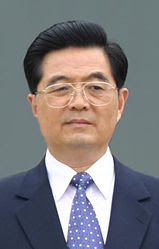 Head of the Communist Party of China since 2002, President of China since 2003, and Head of the Chinese military since 2004, Hu is the man to deal with. Before becoming President, Hu was almost completely unknown outside the very top circiles of the Communist Party. Hu got his start in 1989 when he was sent out to Tibet to run the local chapter of the Communist Party. When the Tibetians rose up in revolt later on that year, it was Hu, not the regional governor who organized the brutal crackdown, and Hu's determination and loyalty to Bejing made him very popular with the government. However, the Tibetians didn't see it that way, and Hu's role in the harsh crackdown made him the most unpopular man in Tibet; later on when the Panchen Lama (the second most important spiritual leader in Tibet) died under mysterious circumstances, many in Tibet accused Hu of having the Panchen Lama murdered.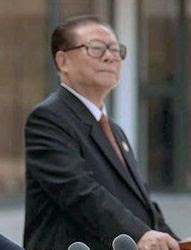
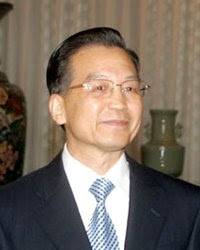 Next up on our list of who's running China is this man, Wen Jiabao, who holds the job of Premir of China. Known for his "man of the people" appeal, the government has turned Wen into its most seen figure. While Hu is usually seen on tv making speaches and reviewing legislation, Wen is usually seen in factories and on farms working with ordanary Chinese dealing with their problems. Wen is also known as a conservative, and has never fell out of the party line. While the excent of Wen's actual power is unknown, it is agreeded that Wen is a potental successor to Hu.
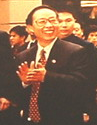 Another top leader in China today is this man, Zeng Quinghong, one of China's two Vice Presidents. Though Zeng does not hold any military posts, he is very close to the Chinese miliary. In the West, Zeng is known (if at all), for his role in the crackdown on the Falun Gong movement.
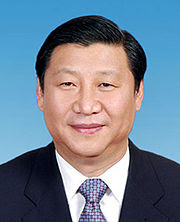 Finnally we have this man, China's other Vice President, Xi Jinping. A recent arrival on the national scene in China, Xi is reported very close to President Hu; in fact, Xi's father was very important in helping Hu out in his early days in politics. Like Jiang, Xi is from Shanghai, and many see him as the other potental successor to Hu. Xi's wife, Peing Liyuan, is a nationally known folk singer in China, and if you want to know why I don't use wikipedia as a source, check out their entry on her.